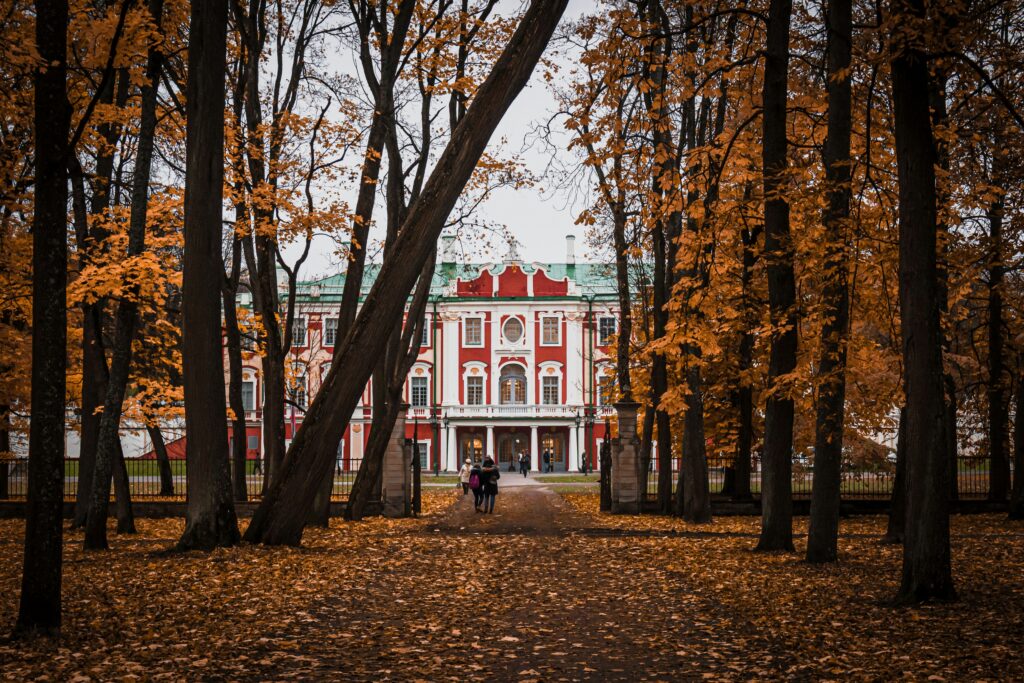
In late June I walked through a Kumu exhibition hall completely alone. Outside it was summer, close to twenty degrees, and the ice cream kiosks in Kadriorg park had queues. Inside it was cool, dim and so quiet I could hear my own steps echoing off the parquet. And from every wall, someone who died a hundred years ago was staring back at me. Portraits, self-portraits, dark oil paintings. The longer I stood there alone, the more certain I became that I was not looking at the paintings. The paintings were looking at me. It is not a pleasant feeling. It is the feeling that makes people in horror films shout at the screen: do not go into that house.
Let me be honest right away: I am not a Kumu fan. I have been there several times, in different seasons, with different people, and every single time I have walked out thinking the same thing. Well. Once is enough. And then, a year or two later, I somehow go again. Maybe because every time it feels like this might be the visit where it finally clicks. Where I finally understand what all those people feel who talk about Kumu with shining eyes. It has not clicked yet. But I have started to understand why, and that is what this article is about. Because the problem is not Kumu. The problem is me. And if you are my type of person, you deserve to know this before you buy a ticket.

A building that earns respect even when the contents do not
Let us start with the part even I will not argue about. The Kumu building is magnificent. Designed by Finnish architect Pekka Vapaavuori, it is dug straight into a limestone cliff, so half the museum hides inside the rock while the other half, a curved tower wrapped in green copper, rises out of the Kadriorg slope like a ship that has run aground. This building has weight. It is not some quickly assembled glass box. Somebody thought hard about it, and I respect that kind of work no matter what hangs inside.
You approach the entrance along a long concrete ramp, limestone on one side, glass on the other. The atrium is tall and full of light, and this time it held a surprise: armchairs knotted together from old car tyres, black and shiny, the tread still clearly visible. Someone took a material that belongs in a landfill and turned it into something you want to touch and sit in. Honestly, those tyre chairs interested me more than quite a few paintings upstairs. That is not sarcasm. That is a compliment to whoever can make a chair out of a tyre.

The silence that turns eerie
But then you go further, to where the real art lives. Floor after floor of Estonian art history: the classics, the Soviet era, contemporary art at the top. The whole story of Estonian art under one roof. On paper it sounds grand, and in substance it is. Kumu is the home of Estonian art and it does that job properly.
On a summer weekday, though, it means something else. The halls are nearly empty. You, the security camera, and the gazes of people long dead. The climate system keeps the air evenly cool, the light is precisely dosed, and there is no sound anywhere except your own steps. Sterile is the right word. Like a hospital where the patients are paintings. I understand why, because oil paint wants stable humidity, not sweaty tourists and noise. But as an experience it feels like walking through a cold storage room. Some people call it peace and meditation. Halfway through a hall I was already looking for the exit door.

And this is where I have to say honestly who this building was actually made for. Kumu is built for the person who can stand in front of one painting for ten minutes and genuinely feel something. Who knows the great names of Estonian classics, or at least wants to learn them. For that person, Kumu may be the best building ever constructed in Estonia, worth a full day. I am not that person. I love museums, but I am drawn to machines, stories and places where you can touch things. In an art museum I get restless within ten minutes, like a child in church. That is not Kumu’s fault. But it needs saying, because half the people who go to Kumu go because “one should”, and they come out as puzzled as I do.
The Kristi Kongi colours that saved the day
And then there is the Kristi Kongi exhibition, “Chromatic Drift”. For me it rescued the whole visit, and it is the reason this article gets to end on an optimistic note.
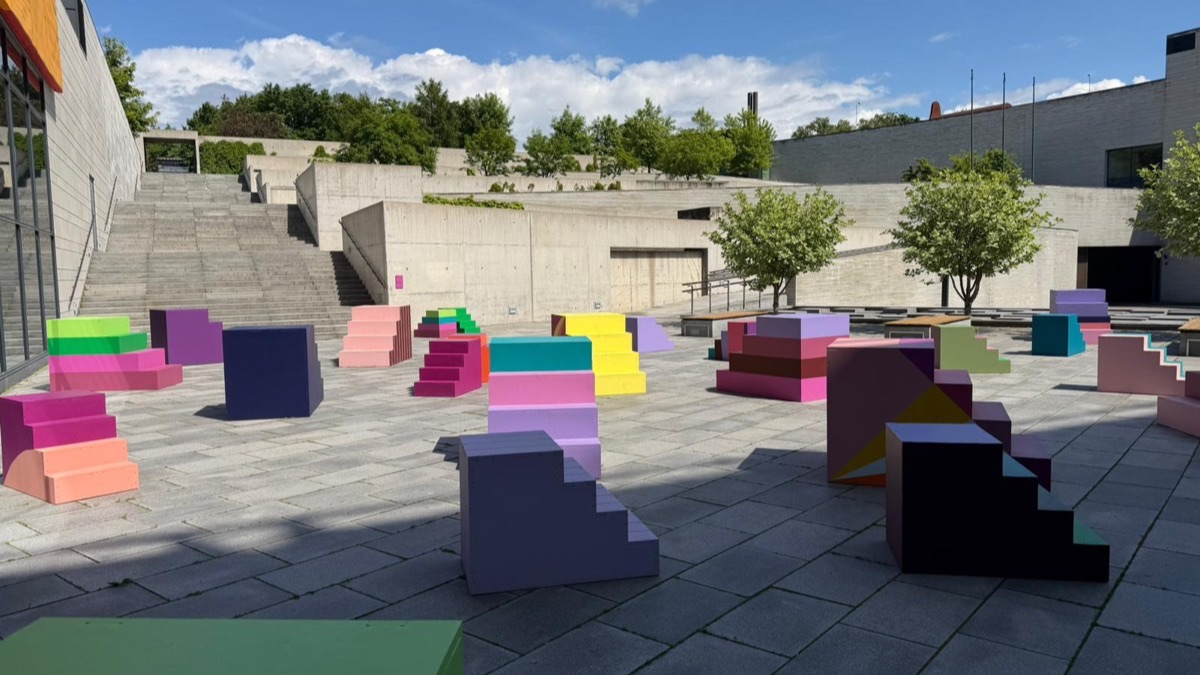
It starts before you even reach the door. Kumu’s inner courtyard, all that stern concrete, is scattered with dozens of staircases in different colours. Pink, purple, yellow, turquoise, lettuce green steps standing on grey stone as if a giant had emptied a box of building blocks and wandered off. The concrete, normally cold, suddenly becomes a backdrop for screaming colour. I lingered in that courtyard longer than in some exhibition halls.

Inside, the same world continues and gets bolder. Green carpet underfoot, walls from pink to purple, paintings that refuse to stay in their frames and flow across walls, floors and doorways. For Kongi a painting is not a thing on a wall but a space you step into. And here something happened to me that had never happened at Kumu before. I did not have to understand anything. I did not need to know the year or the school. I could simply stand in the middle of a green carpet and let the colours do the work. For the first time in this building I felt welcome as I am, not as an art museum visitor is supposed to be.

The exhibition runs until 11 October 2026. If you are as sceptical as I am, go now, because this show is a bridge between people like us and this house. The art lovers will get their classics either way.

The practical part, without varnish
Kumu is in Kadriorg, at Weizenbergi 34. The best way to arrive is tram 1 or 3 to the Kadriorg terminus and a ten minute walk through the park, past the swan pond and the palace. That walk is honestly the best part of the experience and completely free. If you drive, there is a paid car park next to the museum, but on a summer weekend do not expect to be first in line.
A full ticket costs 16 euros, concessions 11, a family ticket 32. Children under 8 enter free. For sixteen euros I expect a lot from a museum, and if you are not sure Kumu is for you, do not put that money down right away. Remember this trick instead: on the last Wednesday of every month, entry costs 3 euros. For three euros the experiment is worth it even if you turn out to be on my team. With the Estonian Museum Card you get in free, and if free museums are your thing, I also keep a full list of free museums in Tallinn.
Kumu is open Tuesday to Sunday from 10 to 18, and on Thursdays until 20. Monday is the day off, with one catch that currently works in your favour: the Kongi exhibition stays open on Mondays until 30 September. So if you arrive on a Monday, you will see only the most colourful part of the building. Frankly, that might not be the worst option.

Budget your time according to who you are. An art person disappears in there for three or four hours and comes out happy. Someone like me does the building in an hour and a half, and that is plenty. A Thursday evening is good if you want to take it slow; the cheap Wednesday if you just want to test the waters.
Make Kumu a full Kadriorg day
One more thing these visits have taught me: do not treat Kumu as a standalone stop, treat it as part of a Kadriorg day. If you are coming out here anyway, make it a loop. Start at the tram stop, walk past the swan pond, glance at Kadriorg Palace, which is Kumu’s little baroque brother and also shows art, and finish on the Kumu terrace. In summer the park has ice cream kiosks and benches under every tree, so even if the museum leaves you cold, the day is not wasted. If you want a longer loop, find the Japanese garden, a quiet corner of its own. Families have the Miiamilla children’s museum and playgrounds in the park, so the division of labour is simple: one parent goes to look at art, the other stays in the park with the kids, and you meet at the ice cream stand. That way the art person gets their three hours in peace and nobody suffers. That is Kumu’s biggest trump card: even if the building is not for you, the surroundings are mighty. And if the weather is rotten, that is exactly the right Kumu day: a rainy last Wednesday and three euros is the best culture deal in Tallinn.
You can book ahead: Kumu tickets on Tiqets. If you plan other stops the same day, look at the Tallinn Card.
If you are planning more than one stop, read these next: Museums Open on Monday in Tallinn and Tartu (2026), Halloween in Tallinn 2026: 5 Events Worth Going To and Tallinn Christmas Market 2026: Dates, Prices and Hours. From the same series: Tallinn Maritime Days 2026: Dates, Harbours and Tips From a Local and Computer Museum in Tallinn: Retro Tech & Nostalgia.
Read also
- PROTO Invention Factory Tallinn: Tickets, Tips & Honest Guide
- Seaplane Harbour Tallinn (Lennusadam): Honest Visitor Guide
- Tallinn Photography Museum — A Hidden Gem by Town Hall Square
- Free Museums in Tartu 2026: Tips, Dates, and Routes
- International Museum Day and Tallinn Museum Sunday 2026
Who should go, and who should not
If you read about art, visit exhibitions abroad, or simply want to see the entire story of Estonian art in one building once in your life, go without hesitation. This house was built for you, and you will leave it a different person than I do.
If you are looking for a place where you can press buttons, launch things and try stuff yourself, you want the Proto discovery centre in Noblessner or the AHHAA science centre in Tartu instead. I have also written an honest ranking of the best museums in Tallinn.
And if you are like me, someone who loves museums but gets twitchy in silent art halls? Go on the last Wednesday for three euros. Walk through Kadriorg park, sit in a tyre armchair for a moment, drift through Kongi’s colours, and reward yourself with an ice cream in the park afterwards. The paintings in the classic halls can keep staring. Let them watch someone who actually enjoys it. You and I will take the colours, the park and the ice cream, with a clear conscience, because we did go.

Disclosure: this article may contain affiliate links. If you book or buy through them, we may earn a small commission at no extra cost to you. We only recommend what we believe in.